
 Home
Home Palmy Weather Home
 Contact Us

 MENU
MENU


A late Good Evening - Today was: Friday, 9 October 2026 22:23:53 NZDT
FORECAST:
Partly cloudy skies early will give way to cloudy skies late. Low 12C. Winds ESE at 15 to 25 km/h. It feels like 12.6°C. 3 clothing layers recommended.
 Weather Forecast |
Temperature | : |  14.6°C, 81%
 |
Pressure | : |  1026.7hPa
 |
 Fire Danger |
||
| Wind Speed | : |
 13km/h
 |
Wind Gust | : |
28km/h |
||||
| Air Quality | : | 9 AQI 2.6ug/m3 | Rainfall | : |
 0.0mm 0.0mm |
||||
| Sun Light | : | 0lx, 11.6hrs | Solar UV | : | 0.0UVI 0W/m2 | ||||
|
Last weather station contact: Friday, 09 October 2026 at 22:25:19. Updated in seconds |
|||||||||
|---|---|---|---|---|---|---|---|---|---|
 No current weather


Quick find list: | Historic Local Lightning Graph | Historic Local Lightning Data Table |
| New Zealand Lightning Report | Rain, Thunderstorm & Bad Weather Interactive Maps | Types of Lightning |
Disclaimer: This data is not intended for protection or preservation of life or property. Use discretion when making weather based decisions.
| New Zealand Lightning Report | Rain, Thunderstorm & Bad Weather Interactive Maps | Types of Lightning |
Disclaimer: This data is not intended for protection or preservation of life or property. Use discretion when making weather based decisions.
No Lightning Detected Today
Last Lightning Detected: 2:27:45pm 31/07/2026
Last Lightning Detected: 2:27:45pm 31/07/2026
Helpful Information: "There was lightning and I heard thunder, but nothing was recorded - why?" There are three mains types of lightning. Palmy Weather only records "Cloud-to-Ground" (CG) and "Ground-to-Cloud" (GC) lightning. However the most common types of lightning is "Intracloud" (IC) and Cloud-to-Cloud (CC) lightning. Find out more about the types of lightning here.
Disclaimer: This data is an approximate indication based upon a single receiver with a 50km radius detection range. More accurate data including triangulation for exact lightning strike location could be obtained through multiple sensors spread widely across the city but is not practical and is cost prohibitive. This data not intended for protection or preservation of life or property. Use discretion when making weather based decisions.
Historic Local Lightning Graph
Disclaimer: This data is an approximate indication based upon a single receiver with a 50km radius detection range. More accurate data including triangulation for exact lightning strike location could be obtained through multiple sensors spread widely across the city but is not practical and is cost prohibitive. This data not intended for protection or preservation of life or property. Use discretion when making weather based decisions.
Historic Local Lightning Data Table


Disclaimer: This data is an approximate indication based upon a single receiver with a 50km radius detection range. More accurate data including triangulation for exact lightning strike location could be obtained through multiple sensors spread widely across the city but is not practical and is cost prohibitive. This data not intended for protection or preservation of life or property. Use discretion when making weather based decisions.
Lightning Report for New Zealand (2 hour and 24 hour period)
 |
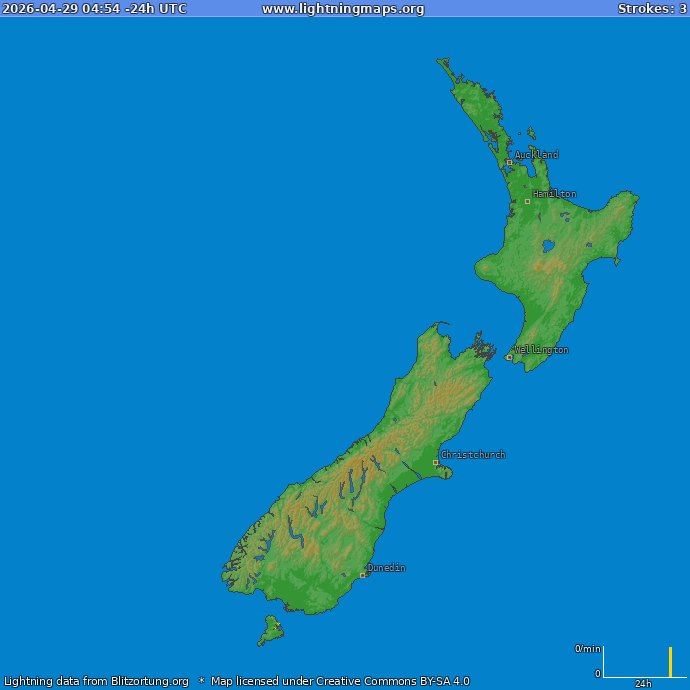 |
| Lightning strikes in the last 2 hours | Lightning strikes in the last 24 hours |
Rain, Thunderstorm and Bad Weather Interactive Maps
About Types of Lightning - In order of prevalence
Intracloud (IC):The most common type of lightning. It happens completely inside the cloud, jumping between different charge regions in the cloud. Intracloud lightning is sometimes called sheet lightning because it lights up the sky with a 'sheet' of light.
Cloud-to-Cloud (CC):
Lightning that occurs between two or more separate clouds.
Cloud-to-Ground and Ground-to-Cloud (CG / GC) [what Palmy Weather is detecting]:
Lightning that connects a cloud to the ground. This can be a negative flash (cloud to ground) or a positive flash (ground to cloud). Cloud-to-ground (CG) and ground-to-cloud (GC) lightning is the most likely type to cause damage to life and property because it makes direct contact with the Earth's surface, although less common than in-cloud lightning.
Cloud-to-Air (CA):
Lightning that occurs when the air around a positively charged cloud top reaches out to the negatively charged air around it.
Bolt From the Blue:
A type of positive lightning bolt that originates in the upper part of a storm, travels horizontally for many kilometres and then strikes the ground at a significant distance from the storm's base. You may not even be aware there is a thunderstorm nearby.
Anvil Lightning:
A positive lightning bolt that develops in the anvil, or the top, of a thunderstorm and travels down to the ground.
Heat Lightning:
A general term for the visible flashes of a distant thunderstorm where the thunder is not heard due to the distance.
Sprites, Wlves, and Blue Jets:
Rare, high-altitude electrical discharges that occur above the clouds in the upper atmosphere and have been studied more recently.


